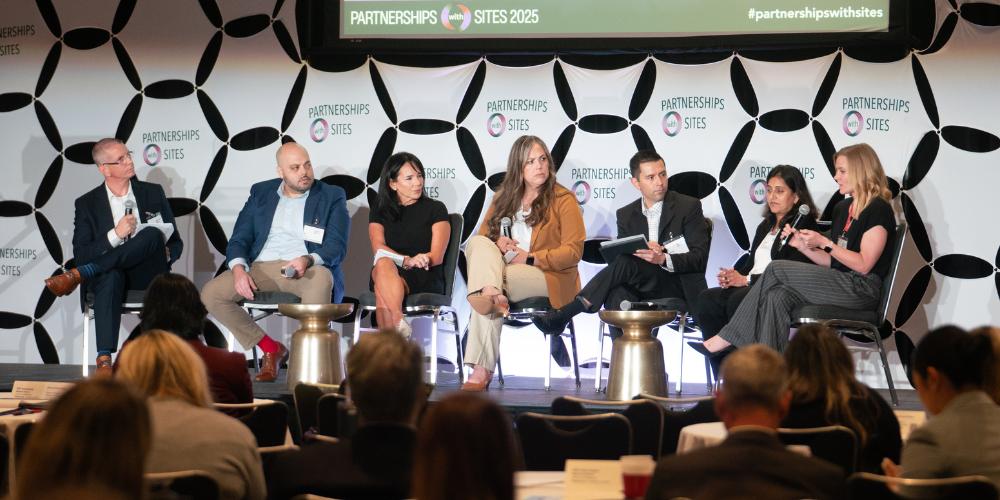
In a panel from Partnerships with Sites 2025, sites, pharma and CROs discussed the necessary relationship-building and infrastructure to form sustainable collaborations that drove greater patient enrollment.
The 5 key takeaways from that conversation were:
- True partnerships are built between individual trials, not just during them.
- Patient perspectives must be embedded into the process from the beginning, and shared amongst all stakeholders.
- Trust sites to be the experts of their own operations, communities, and staffing
- Protocol complexity must be as considered as scientific rigor
- Invest in clinical research sites so that they leave partnerships stronger
True partnerships are built between individual trials, not just during them
The panel emphasized the importance of moving away from a trial-by-trial approach to more long-term engagement between sponsors and sites. That more constant contact allows sites to contribute their expertise to activities like protocol development, as well as sponsors to anticipate any potential challenges. For example, Biogen’s Global Head of Country Site & Operations, Emilio Neto, described a scenario in which they were unsure about a certain part of the protocol. “We called some sites, and they said, “If you try to do this, it will not fly,” said Mr Neto.
Deeper, more long-term engagement also gave sites the comfort of providing their true thoughts to sponsors. “If you know your sponsor over the long term, you’re more open to giving feedback because you’re not worried about being dropped from the study,” said Dr Jyoti Angal, Director of Clinical Research at Avera McKennan Hospital & University Health Center.
Patient perspectives must be embedded into the process from the beginning, and shared amongst all stakeholders.
Patient experience directly impacts recruitment, retention and site workload, but the panelists emphasized that too often, insights from patients aren’t circulated to those designing and executing the trials.
Sano Genetics’ Head of Clinical Recruitment and Engagement, Kendall Davis, said, “We are good at developing protocols from the perspective of the data we need, but we can forget about the human aspect of what we’re asking of people.”
Trust sites to be the experts of their own operations, communities, and staffing
Leslie Dowling, a site manager at Sun Valley Research Center, said that a common misconception was that sites are “endlessly flexible,” when the reality is that they often operate with limited staff and strict regulatory requirements. Not fully understanding the reality on the ground for sites can cause sponsors to unintentionally disrupt site operations.
Dr Angal said that even small shifts in a protocol can require internal renegotiation between different teams. The solution would be greater transparency: if sponsors can share what is coming in their pipeline, sites can better plan staffing, necessary trainings, and outreach.
Protocol complexity must be as considered as scientific rigor
Increasing protocol complexity is not a new phenomenon, but the panel focused on the excessive burden imposed on sites and patients as a result, and how to work through it. Ms Davis said that, in a previous organization, she encouraged site run-throughs with patient advocates. The goal would be to run through a site visit, and identify potential areas of burden or opportunities to improve. Incorporating the patient advocate perspective enriched the protocol with lived experience data.
Kelly Franchetti, CEO, The Patient View, detailed an experience with a working group, in which the biggest need that came up was communication. “It’s all about education. What we’re hearing from patients consistently is, ‘I’m willing to do it, but tell me why, and in terms I can understand.’”
Invest in clinical research sites so that they leave partnerships stronger
The panel shared that too often, sites invest heavily in resources to stand up a trial, but don’t see the long-term pay-off once the trial ends. Dr Angal argued that sponsors should think beyond a single protocol, to support reusable infrastructure, training and other capabilities. Other actions, like better technologies that reduce redundancy or improve communications, benefit sites beyond a single trial.
Conclusion
The typical site-sponsor-CRO relationship has been built around individual trials. But as trials grow in complexity, and tackle different phases of diseases, the model has to adjust to prevent sites from taking undue burden, ensure sponsors are getting the data they need, and support CROs to improve patient and overall trial experience.
True trust between all stakeholders, the panelists highlighted, require long-term investment.
Panelists highlighted in this article
Shafaat Ali Khan
Clinical Research Lead (CRL) Director – Investigator Engagement
Eli Lilly & Co
Shafaat Ali Khan, MBBS is a seasoned clinical research professional with a passion for revolutionizing the way clinical trials are conducted. As a Clinical Research Lead in Lilly’s Site and Investigator Engagement organization, Dr Khan spearheads efforts to operationalize and execute highly decentralized clinical trials, driving efficiency and innovation in the field. He also leads multidisciplinary teams at Lilly to closely collaborate with sites and investigators to drive innovation across the drug development lifecycle.With a strong focus on patient empowerment, Dr Khan is on a mission to enhance patient education and improve access to novel investigational therapies and diagnostics. By leveraging advanced technologies and patient-centric approaches, Mr Khan strives to break down barriers and ensure that more individuals can benefit from cutting-edge treatments.Dr Khan received a Bachelor of Medicine, Bachelor of Surgery (MBBS) degree from Baqai Medical University and continued on to complete a Postdoctoral Fellowship in Cardiovascular Science Research from Emory University School of Medicine.
Jyoti Angal, PhD
Director, Clinical Research
Avera Mckennan Hospital & University Health Center
Dr. Jyoti Angal is the Director of Clinical Research at the Avera McKennan Hospital and Assistant Professor in Pediatrics at the University of South Dakota School of Medicine. Dr. Angal has over 15 years of experience leading large-scale and multi-site research projects with extensive work in rural and tribal communities in the Northern Plains. She is recognized for her contributions to understanding the ethical implications of clinical research in rural, underserved, and vulnerable populations. Dr. Angal has served on several national committees, including the Secretary of the Health Human Services’ Advisory Committee on Human Research Protections (SACHRP). Dr. Angal’s research interests are in the area of maternal and child health, with emphasis on pathways to increase clinical research participation in rural areas.
Emilio Neto, MBA
Global Head of Country Site & Operations
Biogen
tbd
Leslie Michelle Dowling
Site Manager/Regulatory & Compliance Specialist
Sun Valley Research Center, Inc
Leslie Michelle Dowling is the Site Manager at Sun Valley Research Center, where she has dedicated the past 13 years to advancing clinical research and ensuring operational excellence. A proud Hispanic professional and fluent bilingual speaker, Michelle brings a culturally competent approach to patient care and community engagement. She has extensive experience in regulatory compliance, team leadership, and patient-centered trial coordination. Michelle holds a Bachelor of Science in Applied Management and is deeply committed to fostering ethical, collaborative, and impactful research practices. Her leadership is grounded in a servant leadership philosophy that prioritizes team development, patient care, and long-term success.
Wouter Daniëls, MSc
Patient & Site Engagement Lead
Boehringer Ingelheim
Wouter Daniels MSc is a Medical Biologist by training. He has over 20 years of experience working in Clinical Development & Operations in both project management and leadership positions. Since Feb 2022 he is working as a clinical trial Patient & Site Engagement Lead for the global organization of Boehringer-Ingelheim.He started his career at Eli Lilly, worked for 10 years at Novo Nordisk and since 2013 for Boehringer Ingelheim. He has a special interest for the cardiometabolic indications like diabetes, obesity, NASH, CKD and Heart Failure.Since 2018 he is actively working on patient and site engagement focusing on optimizing the clinical trial experience for trial participants and clinical trial site staff in Boehringer trials. In 2023 he created the Site Engagement Academy within Boehringer Ingelheim which was rolled out globally in 2024.
Kendall Davis, MPH
Head of Clinical Recruitment & Engagement
Sano Genetics
Kendall Davis, MPH (she/her) is a seasoned healthcare advocate and the Head of Clinical Recruitment & Engagement at Sano Genetics, where she drives patient-centric strategies to accelerate clinical trial enrollment and foster meaningful engagement with rare disease communities. With more than a decade of experience spanning biotech, clinical research, and nonprofit leadership, she has built a career at the intersection of patient advocacy and clinical development.
Prior to joining Sano Genetics, Ms Davis was the Head of Patient Advocacy Strategy at ICON plc’s Center for Rare Diseases. She has also held leadership and advocacy roles at Spark Therapeutics, PRA Health Sciences, and Global Genes—a leading rare disease nonprofit. Across these roles, she has cultivated strategic alliances with patient organizations, key opinion leaders, community advocates, industry partners and researchers to ensure that research and development efforts reflect the real needs of patients and their families.
Her approach to partnership is rooted in empathy, collaboration, and measurable impact. She has contributed to industry publications on patient engagement and clinical trial readiness, and her work has supported hundreds of families navigating the rare disease journey. In addition to her professional roles, she serves as a Board Member for Team Telomere, advocating for individuals affected by telomere biology disorders.
Passionate about bridging the gap between industry and the patient voice, Ms Kendall brings a unique perspective to multi-stakeholder collaborations aimed at advancing research, improving trial experiences, and ultimately driving better outcomes for patients worldwide.